← Back to GeminiPulse Home & Build Chronicle
Making the Switch: The Webmaster's Rosetta Stone from WordPress, FTP & cPanel to Google Antigravity
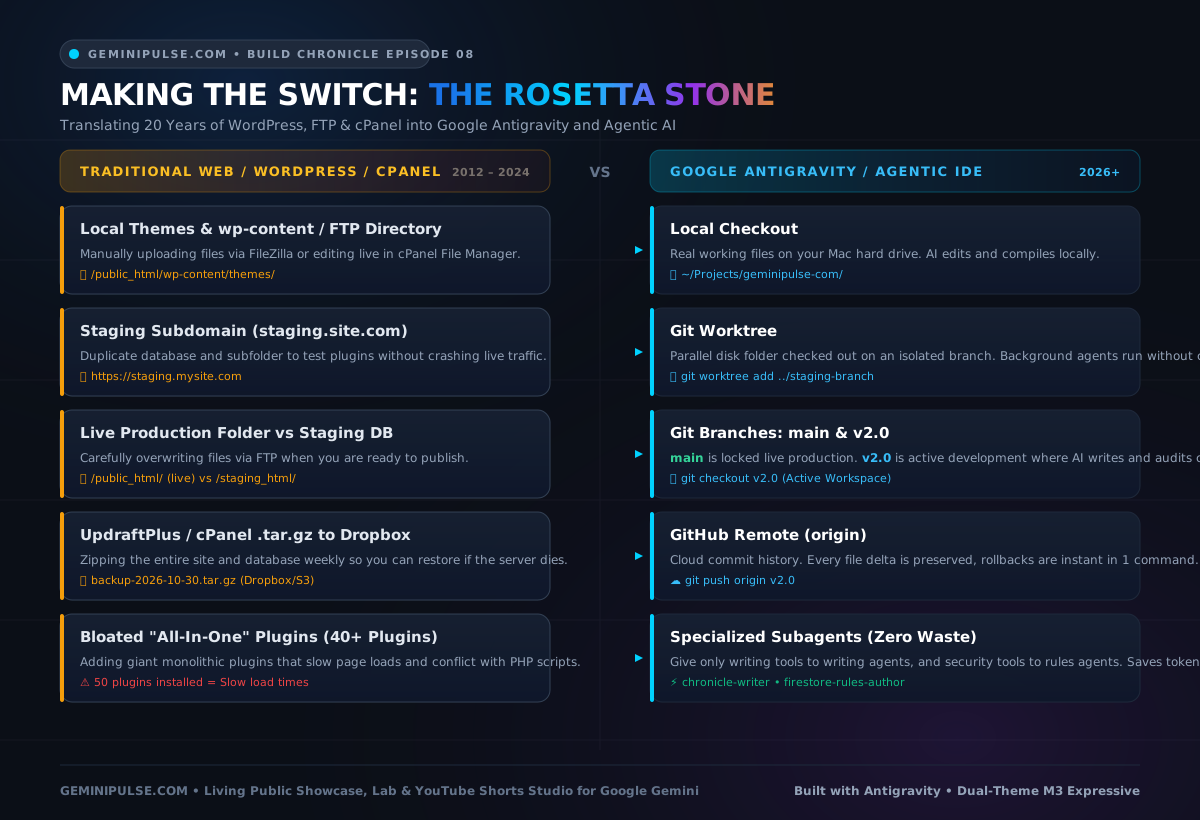
If you have spent 15 to 20 years building websites as a solo webmaster or agency owner, you have deep muscle memory in FTP, cPanel, and WordPress. Agentic IDEs can feel foreign, but they are simply the modern, automated evolution of the exact workflows you have been running for years. Here is the direct translation.
1. The Webmaster's Rosetta Stone
| Traditional Web / WordPress / cPanel | Google Antigravity / Agentic IDE | The Practical Reality |
|---|---|---|
Local Themes / wp-content & FTP |
Local Checkout | The real working files on your hard drive. In Antigravity, the AI reads and edits here in real-time. |
Staging Subdomain (staging.site.com) |
Git Worktree | An instant duplicate folder checked out to a separate branch. Background AI agents can build without touching your open files. |
Live Production Server (public_html/) |
Branch main |
Locked, pristine production. Never edited directly; only updated after automated builds pass. |
| Staging / Feature Branch | Branch v2.0 |
Active development workshop where you and the AI experiment, refactor, and audit. |
| Nightly Backups to Dropbox/S3 | GitHub Remote (origin) |
Your offsite disaster vault. Every commit is tracked, and full rollbacks take 1 click. |
| 40+ Bloated WordPress Plugins | Specialized Subagents | In WordPress, 50 plugins slow down your server. In AI, 50 tools burn context tokens and cause hallucinations. Subagents keep agents lean. |
2. Why You'll Never Overwrite Production by Mistake Again
Remember the cold sweat of editing a live PHP file over FTP and seeing a 500 Internal Server Error? In Git and Antigravity, your production site on main is completely isolated. You build on v2.0, test with automated headless browser audits (npm run audit:ui), and only merge when everything passes.
3. Specialization Over Monoliths
In traditional CMSs, the easiest answer to every requirement was installing another plugin. In agentic AI, every active plugin adds tool schemas to the model's prompt context. By creating specialized subagents—like an editorial writer with only Search Grounding, or a security auditor with only rule linters—you reduce static token overhead by over 70% and eliminate model confusion.